

Presentation of the E-Book on the Pre-War Jewish Heritage of Liepāja in the Context of the City’s History
The Liepājas ebreju mantojums Foundation has unveiled its newly published e-book, “Liepājas ebreju mantojums pilsētas vēstures kontekstā” (“The Jewish Heritage of Liepāja in the Context of the City’s History”). This comprehensive 150-page volume offers a richly illustrated account of Jewish life in Liepāja prior to World War II, featuring 128 rare photographs and archival images that document the community’s vibrant cultural, religious, and civic life.
The book is a living document, continuously enriched with newly discovered materials contributed by descendants of Liepāja’s Jewish families from around the globe. These include private archives, personal recollections, and invaluable insights into the city’s pre-war Jewish experience.
The presentation of the publication took place in a warm and dignified setting, bringing together scholars, members of the Jewish community, and others committed to preserving and honoring the city’s diverse historical legacy. Translations into English, Russian, and Hebrew are currently underway, with the aim of making this important research accessible to a wider international audience. Currently available in Latvian for online reading, the publication represents a significant and enduring contribution to the documentation and reflection of Liepāja’s multicultural heritage.

izglītība, kultūra, sports, veselība, uzņēmējdarbība
XVI. – XX.
Completion of the Otto Fischer Commemoration Project in Liepāja
On April 26, 2025, a major initiative dedicated to the distinguished Austrian footballer and coach Otto Fischer — a figure who left an indelible mark on the history of Liepāja and Latvian football — reached its successful conclusion. Over the course of two days, five major events were held as part of the program.

The agenda comprised: the unveiling of a commemorative plaque at the “Olimpija” stadium in honor of Otto Fischer and his pre-war team “Olimpija,” often referred to as the “Barcelona of the Baltics”; a memorial bus tour; the inauguration of a photographic exhibition documenting Fischer’s life and achievements; an international conference entitled Otto Fischer’s Football Heritage in Liepāja; and the U8 football tournament, Football with Otto Fischer.
The project, developed over a period of more than ten years by the Liepāja Jewish Heritage Foundation, was dedicated to the comprehensive research of Otto Fischer’s life and contributions, with the aim of restoring the memory of this remarkable Austrian athlete and coach, who led one of the strongest football teams in pre-war Latvia.

The project culminated in a youth celebration: the U8 tournament, Football with Otto Fischer. Six youth teams from Liepāja and South Kurzeme participated, with each young athlete receiving a commemorative medal featuring Otto Fischer’s portrait. Victories were celebrated not only by the young players but also by the spectators, who witnessed inspiring displays of skill, teamwork, and enthusiasm. The Austrian Ambassador awarded a specially prepared tournament cup to the winning team, expressing the hope that this celebration in honor of Otto Fischer would become a lasting tradition in Liepāja.

A particularly significant highlight of the program was the unveiling of a commemorative plaque at the historic “Olimpija” stadium — once the epicenter of Liepāja’s sporting life, home to the “Olimpija” football club and the “Maccabi” athletics club. The plaque was ceremoniously unveiled by the Austrian Ambassador to Latvia, H.E. Bernadette Klösch, alongside Aivis Tints, Head of the Sports Department of the Liepāja City Municipality.

As a gesture of appreciation, the Austrian guests were presented with a book on the history of the “Liepājas Metalurgs” sports club, which, since its founding in 1996, has recognized itself as the successor to the pre-war “Olimpija” and was among the first to acknowledge Fischer’s legacy.
Following the unveiling ceremony, participants embarked on a memorial bus tour, In the Footsteps of Otto Fischer, visiting locations associated with Fischer’s life in Liepāja, as well as the Šķēde Memorial — the site where his wife, Anna, was tragically murdered. The tour offered a vivid reconstruction of the atmosphere of pre-war Liepāja — a city renowned for its vibrant cultural and sporting life.

The focal point of the project was the opening of the photographic exhibition, presented in conjunction with the international conference dedicated to Otto Fischer’s legacy.

The conference commenced with the presentation of Dr. Alexander Juraske’s monograph, Otto “Schloime” Fischer: A Jewish Football Star from Vienna. Dr. Juraske recounted Fischer’s early career with the “Hertha” club in Vienna’s Favoriten district — a team that remained among Austria’s elite for 17 seasons — and his later contributions to the Jewish club “Hakoah.” Particularly noteworthy was Fischer’s unwavering loyalty to his former teams, exemplified by his return to “Hakoah” during its most challenging times, and later by his devotion to the development of football in Liepāja. Fischer’s coaching work extended beyond “Olimpija” to include collaboration with regional teams and the “Maccabi” club of Liepāja.

The conference also explored Fischer’s tragic fate during the Holocaust. Although members of his team made efforts to save him, they were ultimately unsuccessful. However, new research indicates that Fischer did not perish during the initial wave of executions of European refugees, as previously believed — an important finding that highlights the need for continued study of his life and final years.
The conference brought together representatives of the Liepāja municipal administration, historians, guides, students, members of the Jewish community, and other guests. A particularly moving moment was the speech delivered by Professor Robert Baig, Otto Fischer’s grandnephew, who shared poignant family memories.

Contributions from invited experts generated significant interest. BBC journalist and University of Manchester lecturer Vince Hunt, who has dedicated more than a decade to researching Fischer’s story, discussed the tactical similarities between Fischer’s “Olimpija” and the renowned Barcelona FC, coining the term “Barcelona of the Baltics.” Raimonds Kāže, a leading researcher of pre-war Latvian sports photography, presented archival discoveries, while Endijs Šlampe, Director of the Liepāja Football School, spoke about the impact of historical figures like Fischer on the development of contemporary coaching methods and strategies.

A special surprise for the conference participants was a performance by a string quartet, featuring works by Latvian, Austrian, and Jewish composers, providing a cultural and emotional resonance to the day’s proceedings.
In his concluding remarks, Ilja Lensky, Director of the Museum “Jews in Latvia,” emphasized the importance of studying sports history as an integral component of collective memory and Holocaust education.
During the informal discussions that followed, participants unanimously agreed that the work of commemorating Otto Fischer must continue. Thus, the project’s principal aim was achieved: the name of Otto Fischer now once again resounds in Liepāja, inspiring new generations.
We extend our sincere gratitude to the Latvian Jewish Community Restitution Fund, whose generous financial support made the realization of this project possible.
We are also deeply grateful to the Embassy of Austria in Latvia and to our dedicated partners from Vienna, Manchester, Riga, and Liepāja, who supported our Foundation throughout every stage of preparation.
Special thanks are extended to Aivis Tints, Davids Jansons, Anna Petrova, Vlada Dobrenka, Raimonds Kāže, Laja Auersperg-Trautson, Benedikt Etz (Austria), and Vince Hunt (United Kingdom) for their invaluable contributions.

Commemorative Events Dedicated to Otto Fischer, Austrian Footballer and Coach, within the Project “Otto Fischer and His Football Legacy in Liepāja”
On April 25 and 26, 2025, events will take place in Liepāja honoring the remarkable yet forgotten Austrian footballer and coach Otto Fischer.
The events are organized by the Liepāja Jewish Heritage Foundation in cooperation with Austrian partners, the Liepāja Sports Department, and mark the conclusion of a comprehensive research project on Otto Fischer’s life, work, and his contribution to football in Liepāja. This project is a tribute to Liepāja’s 400th anniversary, revealing a new chapter in the city’s sports history.
Since 1923, Fischer held a leading position among Austria’s national team players. He played his last match in 1928 during the Nations Cup against Switzerland. After suffering a serious knee injury, Otto was forced to start a coaching career. As a coach, he stood out for his highly effective game strategies and training methods.
Otto Fischer was the head coach of the football team “Olympia” from 1936 to 1940. His refined coaching style, based on technical skills and tactical thinking, helped “Olympia” win three Latvian championships. Otto Fischer’s life was tragically cut short during the Holocaust in Liepāja in 1941.
HEARTFELT THANKS to our partners and sponsors for their valuable support and contribution:
The Latvian Jewish Community Restitution Fund, the Open Public Foundation “Liepāja Jewish Heritage,” the Austrian Embassy in Latvia, the Liepāja Sports Department, Football Club “Liepāja,” the Liepāja Football School, and the Liepāja Jewish Congregation.
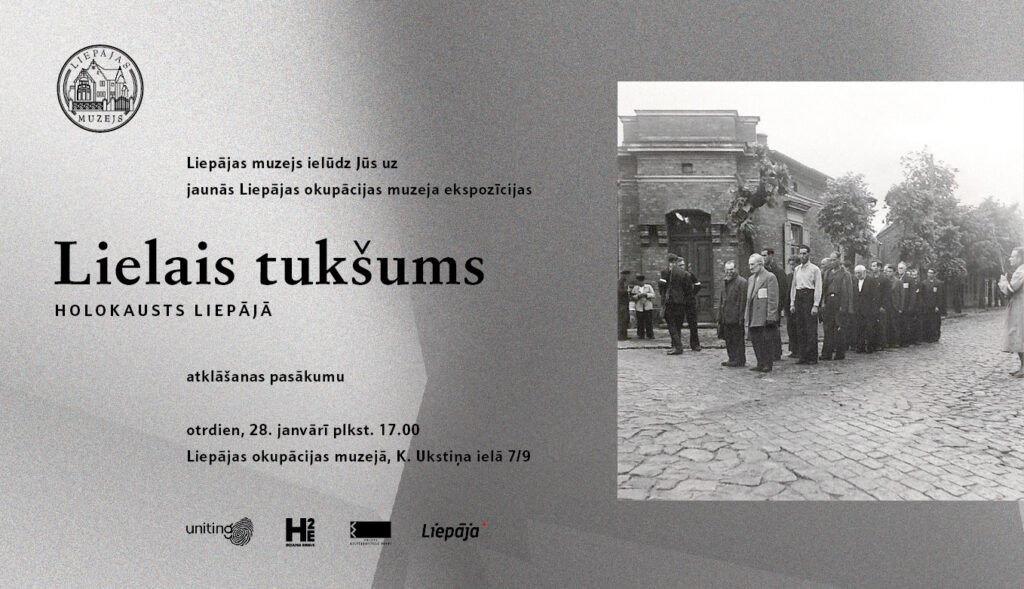
On January 28, with the generous financial support of the Uniting Foundation, a new exhibition commemorating the Holocaust in Liepāja was inaugurated at the Liepāja Occupation Museum.
January 25
On the eve of International Holocaust Remembrance Day, a classical music concert was held in solemn tribute to the occasion. Members of the Jewish community, along with invited guests, gathered to honor the memory of the six million Jews who perished during the Holocaust, as well as those courageous individuals who risked their lives to protect and save Jews from persecution.
International Holocaust Remembrance Day is observed annually on January 27—the date marking the liberation of the Auschwitz concentration camp by Soviet forces. This day of remembrance was officially established by the United Nations in 2005.
Event organized by:
The Foundation “Liepājas ebreju mantojums” and the Jewish Community Board